
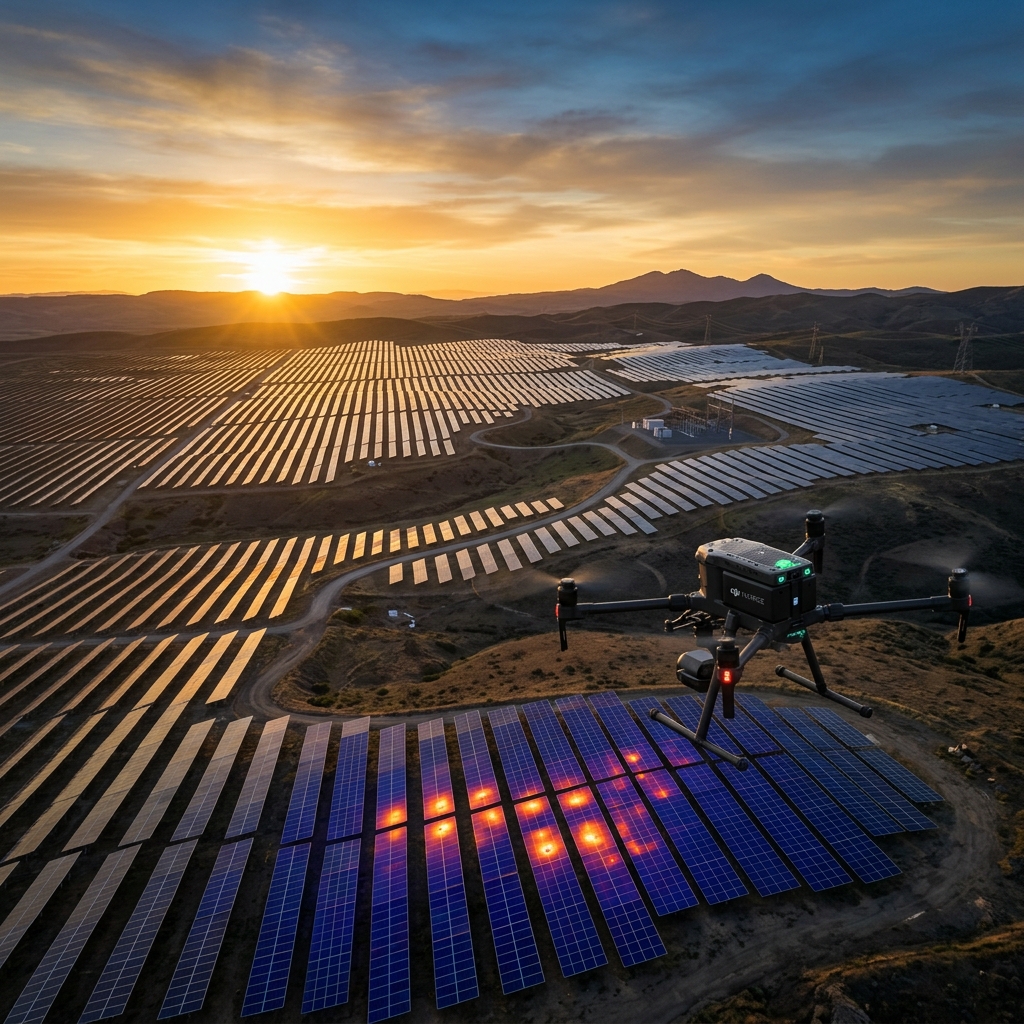
If you operate a solar power plant, rooftop solar installation or utility-scale solar farm, understanding its condition is essential for maintaining consistent performance. Drone-based solar inspection helps asset owners examine large photovoltaic (PV) installations using aerial RGB imaging, thermal imaging and geospatial data.
One of the first questions plant owners and operations teams ask is: How much does drone solar inspection cost in India?
There is no single fixed price for every solar inspection project. The final quotation depends on the installed capacity, site layout, location, inspection technology, data-processing requirements and reporting scope. A compact rooftop installation and a large utility-scale solar farm require different planning, equipment deployment and processing efforts.
This guide explains how drone solar inspection pricing is structured in India, what affects the cost, what should be included in a professional quotation and how to evaluate an inspection provider before making a decision.
Need a project-specific inspection quotation? Share your plant capacity, site location and inspection objectives with Agmay's drone solar inspection team to receive a scope-based proposal.
How Much Does Drone Solar Inspection Cost in India?
Drone solar inspection costs are generally calculated using one or more of the following pricing models:
- Per megawatt (MW) of installed capacity
- Per site or installation
- Per inspection project
- Per deployment day
- Custom pricing for recurring inspection programmes
The appropriate model depends on the size and complexity of the installation.
For example, a large solar farm with a continuous layout may be priced differently from several smaller solar installations spread across different locations. Even when their combined capacity is similar, travel, mobilisation, flight planning and data processing can change the total project cost.
It is therefore better to request a project-specific quotation than rely on a single advertised price per MW.
Why Is There No Fixed Price per MW?
Installed capacity is an important pricing factor, but it does not describe the entire inspection workload.
Two solar plants with the same capacity may have different:
- Land areas and panel-row configurations
- Distances between blocks
- Terrain and site-access conditions
- Module layouts and mounting arrangements
- Inspection coverage requirements
- Thermal and RGB data requirements
- Reporting and delivery expectations
A quotation should account for these differences instead of calculating the project cost using capacity alone.
Common Pricing Models for Drone Solar Inspection
Inspection providers may use different pricing structures depending on the project.
1. Per-MW Pricing
Per-MW pricing is commonly used when inspecting utility-scale solar farms.
The provider estimates the project cost using the installed capacity and adjusts the quotation according to site layout, travel, inspection scope and deliverables.
This model can make comparisons easier when multiple providers are quoting for the same plant. However, the scope must be identical. A thermal-only survey should not be compared directly with a thermal and RGB inspection that includes detailed defect mapping and reporting.
Best suited for:
- Large solar farms
- Utility-scale PV installations
- Multiple inspection blocks within one project
- Recurring plant inspections
2. Per-Site Pricing
Per-site pricing is useful for rooftop solar systems, commercial installations and smaller projects.
The quotation is calculated for the complete installation rather than using a simple MW rate.
Factors such as roof accessibility, building height, surrounding structures, flight restrictions and the number of separate rooftops can influence the price.
Best suited for:
- Residential rooftop solar
- Commercial buildings
- Industrial rooftops
- Small and medium-sized solar installations
3. Project-Based Pricing
Some projects require a combination of inspection, mapping, image processing and customised reporting.
In these situations, a provider may prepare a project-based quotation that covers the complete scope of work.
This is useful when the client needs additional deliverables such as site maps, georeferenced imagery, defect registers or comparison with earlier inspection data.
Best suited for:
- Complex solar installations
- Multi-location inspection projects
- Specialised inspection requirements
- Projects requiring customised reports
4. Annual or Recurring Inspection Contracts
Solar asset owners may need inspections at regular intervals rather than a single visit.
A recurring agreement can define the number of inspections, inspection scope, reporting format, scheduling requirements and data retention arrangements.
The commercial advantage depends on the number of sites, frequency of visits and mobilisation requirements. Do not assume that an annual contract automatically provides a discount; request the total contract value and per-visit cost separately.
What Factors Affect Drone Solar Inspection Cost?
Understanding the factors behind a quotation helps you evaluate whether the proposed price is reasonable for the work involved.
1. Solar Plant Capacity and Layout
The total installed capacity is one of the first details an inspection provider will request.
However, the physical layout also matters. A compact solar farm with accessible blocks may require less mobilisation and planning than a similarly sized plant spread across multiple disconnected areas.
The provider may consider:
- Total installed capacity
- Number of inspection blocks
- Module-row arrangement
- Distance between blocks
- Land area and terrain
- Available site-layout drawings
Providing an accurate plant layout can help the provider estimate the work more efficiently.
2. Location and Mobilisation
The inspection team's travel and deployment requirements contribute to the total cost.
Remote sites may require additional transport, accommodation, equipment movement and coordination with the plant's operations team.
If multiple plants are located within the same region, combining them into one deployment may reduce repeated mobilisation requirements. This should be evaluated against the schedule and inspection conditions of each site.
3. Thermal Inspection Requirements
Thermal imaging is used to identify temperature patterns and potential anomalies across PV modules and associated components.
The cost can depend on:
- Thermal camera specifications
- Radiometric data requirements
- Required inspection resolution
- Flight planning and coverage
- Image processing
- Anomaly identification and reporting
A quotation should state whether it includes radiometric thermal data or only thermal images for visual review.
Thermal anomalies are indicators for further investigation, not automatic confirmation of a specific electrical or module defect. Environmental conditions and operating parameters can influence thermal observations.
4. RGB Imaging Requirements
High-resolution RGB imagery helps identify visible conditions such as:
- Broken or visibly damaged modules
- Surface contamination and soiling
- Vegetation encroachment
- Visible cable or infrastructure issues
- Physical obstructions and shading
- Changes in site conditions
The required image resolution, coverage and processing detail can affect the project scope.
If both RGB and thermal inspection are required, confirm whether the provider will deliver corresponding imagery and whether findings can be geographically associated.
5. Data Processing and Analytics
Collecting images is only one part of the inspection.
The captured data may need to be processed, organised and reviewed before it becomes useful to the plant's operations team.
Depending on the agreed scope, processing may include:
- Thermal image analysis
- RGB image review
- Georeferencing
- Orthomosaic generation
- Potential anomaly identification
- Defect-location mapping
- Image annotation
- Report preparation
Automated or AI-assisted analysis may help prioritise image review, but the quotation should explain what is automated, what is reviewed by a specialist and what level of verification is provided.
6. Reporting Requirements
A basic image collection and a detailed inspection report are different deliverables.
A detailed report may require additional processing and quality checks. Before comparing quotations, establish whether the report includes only summary observations or also provides location references, annotated images, thermal evidence and a structured defect register.
The report format should match how the asset owner's engineering and O&M teams intend to use the findings.
7. Site Conditions and Operational Coordination
The inspection may require coordination with the plant's operations team, security personnel and site management.
Access restrictions, active maintenance work, nearby infrastructure, weather and flight-safety considerations can affect the deployment plan.
Drone operations in India must follow applicable rules and airspace restrictions. The intended operating area should be checked before the inspection is scheduled.
RGB vs Thermal Drone Solar Inspection: Does the Scope Change the Cost?
Yes. RGB and thermal imaging serve different inspection purposes, and the selected scope affects the equipment, data collection and analysis required.
| Inspection scope | Main purpose | Typical deliverables |
|---|---|---|
| RGB imaging | Visual review of visible conditions | High-resolution images, visual observations |
| Thermal imaging | Identify temperature anomalies | Thermal images, potential anomaly observations |
| RGB + thermal | Combine visual and thermal evidence | Corresponding imagery, mapped observations |
| RGB + thermal + mapping | Add spatial context | Georeferenced imagery, maps and location references |
| Detailed reporting | Support engineering and O&M review | Annotated findings, defect register and recommendations |
The best option depends on the inspection objective.
For a routine visual review, RGB imagery may be sufficient. For identifying potential overheating patterns, thermal imaging may be necessary. A combined approach can provide more context when reviewing potential issues.
However, neither RGB nor aerial thermal imaging should be presented as a replacement for every form of electrical testing. Some internal module defects require specialised diagnostic methods.
What Should Be Included in a Drone Solar Inspection Quotation?
A professional quotation should clearly describe the services being purchased.
Use the following checklist before approving a proposal.
1. Project and Inspection Scope
The quotation should identify:
- Solar plant name and location
- Installed capacity
- Number of sites or inspection blocks
- Inspection coverage
- RGB, thermal or combined inspection
- Any excluded areas or components
2. Drone Deployment
Confirm whether the price includes:
- Equipment mobilisation and demobilisation
- Flight planning
- Site coordination
- Remote pilot and operational team
- Applicable airspace checks and permissions
- On-site data collection
The provider should clarify any additional travel, accommodation or rescheduling charges.
3. Data Collection Specifications
Ask the provider to state:
- Whether thermal imagery is radiometric
- RGB image resolution and intended coverage
- Expected image or data deliverables
- Whether the imagery will be georeferenced
- Any environmental or operating conditions required
A quotation that simply says "thermal drone inspection" may not provide enough technical detail to evaluate the actual scope.
4. Data Processing and Reporting
Confirm whether the quotation includes:
- Image processing
- Thermal anomaly review
- RGB visual observations
- Location references or defect mapping
- Annotated images
- Inspection summary
- Structured defect register
- Corrective-action recommendations, where supported by the findings
Also confirm the report format, delivery timeline and whether the client receives the original captured data.
5. Commercial Terms
Review the following before approving the project:
- Total project cost
- Taxes and applicable charges
- Advance payment requirements
- Additional mobilisation costs
- Weather-related rescheduling terms
- Report delivery timeline
- Data ownership and retention
- Scope-change charges
A clear quotation reduces the likelihood of disagreements after the inspection.
How to Compare Two Drone Solar Inspection Quotations
Do not select a provider based only on the lowest price.
Two quotations may look similar but include very different inspection coverage and deliverables.
Consider this example:
| Evaluation point | Provider A | Provider B |
|---|---|---|
| Thermal inspection | Included | Included |
| RGB inspection | Not included | Included |
| Radiometric data | Not specified | Clearly specified |
| Georeferenced findings | Not specified | Included |
| Annotated report | Summary only | Detailed report |
| Original data handover | Not specified | Clearly specified |
| Mobilisation | Additional | Included |
This is an illustrative comparison, not an actual supplier quotation. It demonstrates why the scope should be evaluated alongside the price.
A useful approach is to ask every shortlisted provider to quote against the same scope document. This makes the commercial comparison more meaningful.
How to Prepare for a Solar Drone Inspection and Avoid Unnecessary Costs
Good preparation can reduce delays and avoid additional deployment requirements.
Before requesting a quotation, prepare the following information:
- Plant capacity: Share the installed capacity in MW or kW.
- Site location: Provide the exact project location and access details.
- Plant layout: Share available layout drawings, block maps or coordinates.
- Inspection objective: Explain whether the requirement is visual inspection, thermal inspection or both.
- Required coverage: Clarify whether the entire installation or selected blocks need inspection.
- Reporting expectations: Specify whether you need annotated images, defect mapping, a summary report or a detailed register.
- Previous inspection data: If available, share earlier reports for comparison.
- Preferred schedule: Identify suitable inspection windows and site coordination requirements.
Providing this information helps the provider prepare a more accurate proposal and identify potential constraints before deployment.
Is Drone Solar Inspection Worth the Investment?
The value of an inspection should be evaluated against the operational decisions it supports—not simply the number of images collected.
A well-planned inspection can help operations teams:
- Identify potential thermal anomalies for further investigation
- Locate visible module damage and contamination
- Review site conditions across large installations
- Prioritise areas for maintenance checks
- Document observations for future comparison
- Support maintenance planning with location-referenced findings
However, an inspection does not automatically recover lost energy or confirm every suspected fault. The value depends on the quality of the data, the accuracy of the findings and whether appropriate corrective action follows.
A practical way to evaluate the investment is to compare the inspection cost with the operational value of the findings that are verified and acted upon.
Choosing a Drone Solar Inspection Service Provider in India
Before selecting a provider, evaluate more than the advertised price.
Consider these questions:
- Does the provider clearly explain its RGB and thermal inspection capabilities?
- Can it describe the equipment and data specifications?
- Does it explain the environmental conditions required for reliable thermal observations?
- Are inspection findings location-referenced?
- Does it provide sample report formats?
- Can the provider explain the limitations of aerial inspection?
- Are flight operations planned in accordance with applicable Indian drone regulations?
- Are data ownership, delivery and retention terms clear?
The right provider should be able to explain both what the inspection can identify and what requires additional testing.
For a broader understanding of the inspection process, see our guide to drone solar inspection.
Drone Solar Inspection Services by Agmay
Agmay provides drone-based solar inspection solutions designed to support the assessment and monitoring of solar installations.
The inspection scope can be planned around the project requirements, including thermal and RGB imaging, potential hotspot identification, visual observations, mapping and reporting.
Whether you manage a rooftop installation or a larger solar facility, the first step is to define the plant capacity, site location, inspection objective and expected deliverables.
Request a project-specific inspection quotation
Share your plant capacity, site location, inspection objectives and expected deliverables with Agmay's solar inspection team.
Explore Solar Inspection Services ↗Explore Agmay's drone-based solar inspection services to understand the available service scope. To discuss a project, share your plant details and inspection requirements so that the appropriate scope can be evaluated.
Frequently Asked Questions
1. What is the cost of drone solar inspection in India?
There is no single fixed price for drone solar inspection across India. The quotation depends on plant capacity, site layout, location, inspection technology, mobilisation, data processing and reporting requirements. Request a project-specific quotation with a clearly defined scope.
2. Is drone solar inspection charged per MW?
Per-MW pricing is one common model for utility-scale solar farms. Providers may also quote per site, per project or per deployment. The pricing model depends on the size, layout and complexity of the installation.
3. Does thermal drone inspection cost more than RGB inspection?
The cost depends on the equipment and deliverables included. Thermal inspection requires suitable infrared imaging equipment and thermal data analysis. RGB inspection has a different data-capture and review scope. A combined inspection may involve both sets of requirements.
4. What is included in a drone solar inspection package?
Depending on the quotation, a package may include flight planning, drone deployment, RGB or thermal image capture, data processing, potential anomaly identification, location references and an inspection report. Always confirm the exact inclusions before booking.
5. Does the inspection cost include a detailed thermal report?
Not necessarily. Some quotations include only captured imagery or a basic summary, while others include annotated thermal images, mapped findings and a structured report. Ask for a sample report and written deliverable list before approving the project.
6. Can drone solar inspection be performed on a small rooftop installation?
Yes, drone-based inspection may be suitable for certain rooftop installations. However, building height, access, surrounding structures, airspace restrictions, privacy and safe operating conditions must be assessed before deployment.
7. Does a drone thermal inspection confirm solar panel defects?
A thermal anomaly indicates a temperature pattern that may require further investigation. It does not automatically confirm a specific electrical or module defect. Additional inspection or electrical testing may be necessary to establish the cause.
8. How long does a drone solar inspection take?
The duration depends on plant capacity, layout, access, weather, flight conditions and inspection scope. Data processing and report preparation also take time after field data collection. Ask the provider to quote separate timelines for site work and final report delivery.
9. Can multiple solar plants be inspected under one quotation?
Yes. Multiple sites can be considered under a combined project or recurring inspection agreement. The quotation should identify the cost and scope for each site, along with any shared mobilisation arrangements.
10. How can I get a quotation for drone solar inspection from Agmay?
Share the plant location, installed capacity, available layout, inspection requirements and preferred schedule. These details help establish the project scope and determine the appropriate quotation.
Final Thoughts
Drone solar inspection pricing in India depends on more than installed capacity. The inspection technology, site location, mobilisation requirements, data-processing scope and reporting detail all influence the final quotation.
Before choosing a provider, compare the complete scope of work rather than relying only on the quoted price per MW. Clear deliverables, suitable imaging specifications, location-referenced findings and transparent commercial terms make it easier to evaluate the actual value of an inspection.
For solar asset owners looking to assess their installations, the right starting point is a clearly defined inspection requirement and a project-specific proposal.
Explore Agmay Solar Inspection Services to discuss your project requirements.