
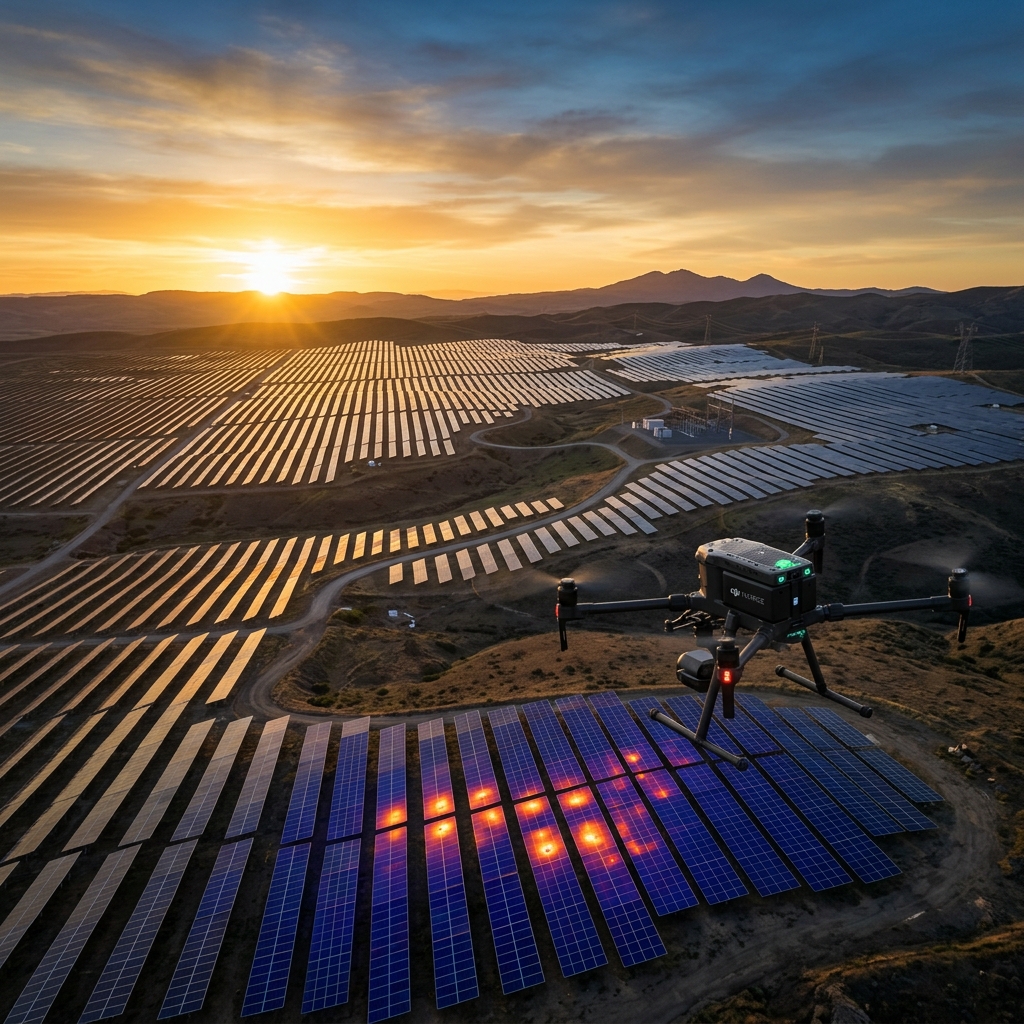
Operating a solar power plant requires continuous monitoring, regular maintenance and timely identification of equipment abnormalities. From photovoltaic (PV) module condition and electrical connections to vegetation management and infrastructure maintenance, every part of a solar installation contributes to its long-term operation.
As solar installations expand in size, operations and maintenance (O&M) teams need efficient ways to collect information across large areas and identify locations that require attention.
Drone solar inspection is becoming a valuable part of this process.
Drones equipped with high-resolution RGB and thermal cameras can collect aerial information across solar installations. When this data is processed and reviewed alongside plant monitoring information, it can help O&M teams identify potential abnormalities, locate affected areas and prioritise further investigation.
Rather than replacing traditional maintenance procedures, drone inspections provide an additional source of visual and thermal evidence that supports preventive maintenance, corrective maintenance and asset management.
This guide explains how drone solar inspection fits into solar plant operations and maintenance, how O&M teams can use inspection findings, what information should be included in reports and how aerial inspection data can contribute to better maintenance decisions.
Planning an aerial inspection for your O&M programme? Explore Agmay's drone-based solar inspection services to discuss thermal screening, mapped defect registers and scheduled plant surveys.
What Is Drone Solar Inspection for Operations and Maintenance?
Drone solar inspection for operations and maintenance is the use of unmanned aerial vehicles (UAVs) equipped with suitable imaging sensors to collect information about the condition of solar power installations.
The collected data can be used to support maintenance planning, asset monitoring and investigation of potential performance issues.
Depending on the inspection scope, drone-based O&M support may include:
- Thermal inspection of photovoltaic modules
- RGB visual inspection
- Potential hotspot identification
- Detection of visible module damage
- Identification of shading and soiling patterns
- Inspection of selected electrical infrastructure
- Vegetation and site-condition assessment
- Inspection observation mapping
- Historical comparison of inspection findings
- Reporting for maintenance teams
The main objective is to help O&M teams understand where potential issues have been observed and determine what should be investigated next.
Drone inspection is not a complete O&M programme. It is one inspection method that can be integrated into a broader maintenance strategy involving monitoring systems, qualified technicians, electrical testing and manufacturer-recommended maintenance procedures.
Why Is Drone Inspection Important for Solar Plant O&M?
A utility-scale solar installation may contain thousands of modules distributed across multiple blocks and large areas of land.
Inspecting every module manually can require substantial field coordination, particularly when teams need to document findings and connect them to precise locations.
Drone inspection can complement existing O&M methods by collecting aerial information across large areas.
1. Better visibility across large installations
Aerial RGB imagery can provide a broader view of panel arrays, site infrastructure, access roads, vegetation and visible physical conditions.
This helps maintenance teams review site conditions and identify areas that may need closer examination.
2. Identification of potential thermal abnormalities
Thermal cameras can reveal temperature patterns across photovoltaic modules and certain associated components.
These observations may help identify potential hotspots, abnormal heating and other conditions requiring technical investigation.
3. Location-based maintenance planning
Georeferenced images and mapped observations can help maintenance teams locate reported findings within the solar plant.
4. Support for preventive maintenance
Scheduled aerial inspections can contribute additional condition information to an existing preventive maintenance programme.
5. Faster prioritisation of follow-up work
When inspection findings are organised by location and observation type, O&M teams can review which areas require further investigation first.
6. Historical inspection records
Repeated surveys can help operators compare observations across inspection periods and maintain a visual record of changes.
How Drone Solar Inspection Supports Different O&M Activities
Solar plant maintenance generally involves several complementary activities. Drone inspection can contribute to some of these activities by providing aerial imagery and thermal data.
1. Preventive Maintenance
Preventive maintenance involves planned activities designed to maintain the condition and reliability of solar plant equipment.
These activities may include visual checks, component servicing, vegetation management, cleaning and scheduled technical inspections.
Drone inspections can contribute to preventive maintenance by providing additional information about:
- Visible module damage
- Potential thermal anomalies
- Surface contamination
- Vegetation-related shading
- Changes in panel or site conditions
- Selected infrastructure observations
For example, a scheduled RGB and thermal survey may help identify areas that require closer inspection during the next maintenance visit.
The inspection schedule should be based on the plant's O&M programme, equipment requirements, site conditions and inspection objectives rather than assuming that every installation requires the same drone survey frequency.
2. Corrective Maintenance
Corrective maintenance takes place after a fault, abnormal condition or equipment problem has been identified.
Drone inspection can support the diagnostic stage by providing additional visual and thermal evidence.
For example:
- Plant monitoring indicates abnormal performance in a particular area.
- The O&M team reviews the affected block or equipment.
- A targeted drone inspection captures relevant RGB and thermal imagery.
- Potential anomalies are identified and mapped.
- Qualified technicians investigate the reported locations.
- Appropriate corrective work is performed.
- Follow-up information is recorded to confirm the result where necessary.
The drone helps with aerial screening and location information. It does not independently perform electrical troubleshooting or confirm every underlying fault.
3. Condition-Based Maintenance
Condition-based maintenance uses the observed condition of equipment to help determine when maintenance or further inspection is required.
Drone inspection can contribute condition information through repeated visual and thermal surveys.
For example, an O&M team may compare the thermal behaviour of selected areas across different inspection periods, taking account of environmental conditions and operating status.
This can help identify observations that need closer technical review.
The value of condition-based maintenance depends on reliable inspection data, appropriate comparison methods and a clear process for deciding what action should follow.
4. Predictive Maintenance
Predictive maintenance uses condition information and analytical methods to estimate the likelihood of equipment degradation or failure.
Drone imagery can contribute to predictive maintenance workflows when combined with other information, such as:
- Inverter performance data
- SCADA measurements
- String-level electrical information
- Historical thermal observations
- Maintenance records
- Weather and irradiance data
- Equipment age and operating history
For example, repeated abnormalities in the same plant area may justify a more detailed engineering investigation.
However, a drone image by itself does not predict when a component will fail. Predictive conclusions require suitable historical data, validated analytical methods and technical interpretation.
Major Solar Plant Issues That Drone Inspections Can Help Identify
Drone inspections can support the identification of visible conditions and potential thermal abnormalities across solar installations.
The actual observations depend on sensor capability, image resolution, operating conditions and inspection methodology.
1. Solar panel hotspots
Thermal imaging can identify localised temperature differences across PV modules.
Potential causes may include cell-level abnormalities, electrical mismatch, bypass-diode issues or other operating conditions.
The thermal pattern should be reviewed in context before assigning a fault diagnosis.
2. Module damage
RGB imagery may reveal visible physical conditions such as:
- Broken or visibly damaged glass
- Discolouration
- Surface deterioration
- Obvious delamination
- Visible corrosion
- Other observable physical damage
Some internal module defects cannot be reliably identified through ordinary aerial RGB imagery.
3. Soiling and contamination
Aerial visual imagery can help identify areas affected by:
- Dust accumulation
- Bird droppings
- Leaves and debris
- Localised contamination
- Uneven cleaning patterns
The actual effect of soiling on energy production should be evaluated using suitable performance information and, where necessary, ground-level measurements.
4. Shading and vegetation growth
Drone imagery can help document vegetation or other visible objects that may create shading across panel arrays.
This can support vegetation management and site maintenance planning.
5. Potential electrical component abnormalities
Thermal imaging may reveal unusual heating patterns around certain accessible or visible electrical components.
Such observations should be treated as screening findings. Qualified personnel must carry out appropriate inspection and electrical verification before deciding on repairs.
6. Changes in site and mounting conditions
RGB imagery can help document visible changes in panel rows, mounting structures, access areas and surrounding infrastructure.
Aerial imagery cannot establish the structural integrity of a mounting system. Physical inspection and engineering assessment may still be required.
Integrating Drone Inspection with Solar Plant Monitoring Systems
Drone inspection becomes more useful when its results are considered alongside existing plant monitoring information.
Most utility-scale solar installations use monitoring systems that provide information about power generation, inverter operation, alarms and other plant parameters.
These systems and aerial inspection data serve different purposes:
- SCADA and inverter monitoring provide operational and electrical information.
- RGB drone imagery provides visual information about modules and site conditions.
- Thermal drone imagery provides temperature-pattern information that may reveal potential abnormalities.
- GIS and inspection mapping connect observations with geographic locations.
Combining these sources can provide a more complete basis for investigating potential plant issues.
Example: Investigating an underperforming solar block
Consider a solar plant where monitoring data indicates that one block is performing differently from expected.
An O&M team may follow this workflow:
- Review the relevant inverter and monitoring data.
- Identify the affected block or suspected area.
- Compare the available electrical and environmental information.
- Conduct a targeted RGB and thermal drone inspection where appropriate.
- Review potential visual and thermal observations.
- Map the observations to their locations.
- Send qualified personnel for ground-level verification.
- Record the confirmed findings and corrective action.
This approach uses drone imagery as supporting diagnostic evidence rather than treating it as a standalone electrical performance measurement.
How Thermal Drone Inspection Supports Solar Maintenance
Thermal inspection is particularly relevant to solar O&M because it provides information about temperature patterns across PV modules.
A properly planned aerial thermography survey can cover large panel arrays and help identify locations that require additional investigation.
The inspection may help reveal patterns associated with:
- Potential hotspots
- Module temperature differences
- Bypass-diode-related thermal patterns
- Junction box heating
- Electrical mismatch
- Selected string-level abnormalities
The quality of thermal observations depends on several factors:
- Thermal camera specifications
- Image resolution
- Flight altitude and viewing angle
- Solar irradiance
- Wind conditions
- Ambient temperature
- Cloud conditions
- Module operating state
- Image processing and interpretation
A thermal anomaly is not automatically a confirmed defect.
The IEA PVPS O&M guidelines explain that aerial thermal imaging quality depends on the sensors, measurement conditions and post-processing methods. They also emphasise the importance of appropriate processing to identify and locate potential PV failure patterns.
For this reason, thermal inspection findings should be reviewed alongside relevant operational information and ground-level testing when necessary.
Building a Drone Inspection Schedule for Solar Plant O&M
Drone inspection frequency should be defined according to the plant's maintenance strategy and site-specific requirements.
There is no single inspection interval that is appropriate for every solar installation.
The schedule may depend on:
- Plant capacity and layout
- Module and equipment characteristics
- Local weather conditions
- Soiling and vegetation patterns
- Historical inspection findings
- Monitoring system alerts
- Maintenance contract requirements
- Manufacturer recommendations
- Risk and performance priorities
1. Baseline inspection
A baseline survey can document the condition of the installation at an agreed starting point.
This may be useful during commissioning, handover or the introduction of a new inspection programme.
2. Scheduled preventive inspection
Periodic aerial inspections can be included in the plant's preventive maintenance plan.
The interval should be selected according to the purpose of the survey and the expected value of the information.
3. Event-triggered inspection
A drone survey may be considered after an event or when operational information indicates an issue requiring additional visual or thermal investigation.
Examples include:
- Severe weather
- Suspected module damage
- Unexplained performance changes
- Repeated monitoring alarms
- Suspected overheating
- Changes in site conditions
4. Follow-up inspection
After maintenance work, a targeted survey may help document the affected area and provide additional evidence for comparison.
However, an aerial image alone should not be used to certify that an electrical or mechanical repair has been completed correctly.
How Drone Inspection Findings Should Be Used by O&M Teams
A drone inspection should produce information that can be acted upon by the people responsible for the solar plant.
A useful workflow connects each observation with evidence, location and an appropriate next step:
- Record the observation: Each relevant finding should have a unique observation reference.
- Identify the location: Use a suitable block, row, module or geographic reference according to the accuracy of the collected data.
- Attach supporting evidence: Include the corresponding RGB or thermal image and any relevant data.
- Classify the finding: Distinguish between visible observations, potential thermal anomalies, suspected defects and findings confirmed through additional testing.
- Assign technical review: The appropriate O&M engineer or qualified technician should review findings that require further investigation.
- Record the maintenance action: Where corrective work is performed, document the action, date, responsible team and relevant equipment information.
- Close the observation: The finding should be marked as resolved only after the required verification has been completed.
This creates a traceable connection between aerial inspection data and maintenance records.
What Should a Drone Solar O&M Inspection Report Include?
A report intended for operations and maintenance teams should be organised around practical maintenance decisions.
Depending on the agreed inspection scope, it may include:
| Report section | Purpose |
|---|---|
| Executive summary | Overview of the inspection and important observations |
| Project details | Plant location, capacity and inspection scope |
| Inspection methodology | Sensors, flight approach and processing |
| Environmental conditions | Relevant conditions during thermal acquisition |
| RGB observations | Visible module and site conditions |
| Thermal observations | Potential temperature abnormalities |
| Location references | Block, row or geographic identification |
| Observation register | Structured list of inspection findings |
| Recommended follow-up | Suggested technical review or investigation |
| Limitations | Areas or issues that could not be reliably assessed |
| Supporting data | Images, maps and other agreed deliverables |
For ongoing O&M programmes, consistent observation IDs and reporting formats are particularly useful because they make historical comparisons and maintenance tracking easier.
For a more detailed explanation of report contents, see our guide to solar inspection reports.
How Drone Inspection Can Support Solar Asset Management
Solar asset management involves monitoring the technical and operational condition of a solar installation throughout its lifecycle.
Drone inspection can contribute useful information to asset management by creating visual and thermal records that can be associated with specific plant locations.
- Historical condition records: Repeated surveys can provide a visual history of selected plant areas.
- Maintenance prioritisation: Mapped observations can help asset managers and O&M contractors organise further investigations.
- Performance investigations: Thermal and visual information can be reviewed alongside plant monitoring data when investigating possible performance issues.
- Documentation and reporting: Inspection reports can become part of the plant's technical records and maintenance history.
- GIS and digital asset systems: Where suitable data integration is available, inspection observations can be linked to geographic asset records and digital site maps.
These benefits depend on consistent data collection, clear reporting and a process for updating maintenance records.
Limitations of Drone Solar Inspection in O&M
Drone inspection is a useful additional inspection method, but it cannot replace every O&M activity.
- It does not replace electrical testing: Drone imagery cannot independently verify insulation resistance, electrical continuity, grounding, connector torque or every string-level electrical fault.
- Thermal observations require interpretation: Temperature patterns can be influenced by irradiance, wind, reflections, shading and module operating conditions.
- Some internal defects are not visible from the air: Microcracks, certain cell-level defects, potential-induced degradation and other internal conditions may require specialised diagnostic methods such as electroluminescence imaging or electrical testing.
- It does not replace physical maintenance: Drones cannot tighten electrical connections, replace modules, clean equipment or repair damaged components unless a separately designed and appropriate specialised system is used.
- Flight and weather restrictions apply: Operations must account for weather, airspace, site safety, workers and surrounding infrastructure.
- Data must be processed and reviewed: Collecting thousands of images does not automatically produce a useful maintenance decision. Image processing, quality checks and technical interpretation remain important.
The best approach is to integrate drone inspection into a broader O&M system that includes plant monitoring, scheduled maintenance and qualified engineering assessment.
Choosing a Drone Solar Inspection Partner for O&M
Solar plant owners and O&M contractors should evaluate a drone inspection provider based on the quality and usefulness of the information delivered.
Important considerations include:
- Solar inspection understanding: Does the provider understand PV module layouts and common visual and thermal observations?
- Suitable sensors: Are the RGB and thermal imaging systems appropriate for the required inspection?
- Inspection methodology: Can the provider explain flight planning and relevant measurement conditions?
- Data processing: Are images reviewed and organised using a clear methodology?
- Location accuracy: Can reported findings be associated with useful site references?
- Reporting: Are findings presented in a format that maintenance teams can use?
- Technical limitations: Does the provider distinguish suspected abnormalities from confirmed faults?
- Regulatory and operational planning: Are applicable flight requirements and site safety arrangements addressed?
- Data handover: Are original images, processed data and reporting deliverables clearly specified?
The right provider should help the O&M team understand what was observed, where it was observed and what further action may be appropriate.
Drone Solar Inspection for O&M by Agmay Technologies
Agmay Technologies provides drone-based solar inspection solutions intended to support solar asset owners and operations teams.
Depending on the project requirements, the inspection scope can include aerial RGB and thermal imaging, potential anomaly identification, visual observations, mapping and inspection reporting.
These capabilities can support solar plant teams in reviewing module conditions, identifying areas requiring further investigation and organising inspection information.
For an O&M inspection project, the appropriate approach depends on plant capacity, site layout, operating conditions, inspection objectives and required deliverables.
Agmay's drone-based solar inspection services can be explored for projects involving rooftop solar installations and larger solar facilities.
Discuss an O&M inspection programme for your solar plant
Share your plant location, installed capacity, layout and reporting requirements with Agmay Technologies.
Explore Solar Inspection Services ↗Visit Agmay Solar Inspection Services to discuss the requirements of your solar plant.
For a complete introduction to the technology, read our guide to drone solar inspection.
Frequently Asked Questions About Drone Solar Inspection for O&M
1. How are drones used in solar plant operations and maintenance?
Drones are used to collect RGB and thermal imagery across solar installations. This information can help O&M teams identify visible damage, potential thermal abnormalities, shading, vegetation and other site conditions that may require further investigation.
2. Can drone solar inspection be included in preventive maintenance?
Yes. Drone inspections can be included in a preventive maintenance programme as an additional method of collecting visual and thermal condition information. The inspection frequency should be based on site conditions, maintenance objectives and the overall O&M plan.
3. Can drones help with corrective maintenance?
Drones can support corrective maintenance by collecting aerial imagery of areas where a fault or abnormal condition is suspected. The findings can help technicians locate areas requiring ground-level investigation and verification.
4. Can drone inspection help identify solar panel hotspots?
Thermal cameras can identify temperature patterns that may indicate potential hotspots or other abnormalities. However, the underlying cause must be evaluated through suitable technical review and additional testing where necessary.
5. How often should solar plants undergo drone inspection?
There is no universal interval for every solar plant. Inspection frequency depends on plant size, site conditions, equipment, historical findings, monitoring alerts and the requirements of the maintenance programme.
6. Can drone inspection replace manual solar panel inspection?
No. Drone inspection can complement manual inspection by collecting aerial visual and thermal data. Physical examination, electrical testing and specialist diagnostics remain necessary for conditions that cannot be reliably assessed from aerial imagery.
7. Can drone inspection be combined with SCADA monitoring?
Yes. Drone observations can be reviewed alongside inverter, SCADA and other operational information. This can help O&M teams investigate suspected performance issues and prioritise further technical assessment.
8. What information should an O&M drone inspection report contain?
A useful report may include the inspection scope, methodology, RGB and thermal images, observation locations, descriptions, supporting evidence, recommended follow-up actions and limitations.
9. Can drone inspection identify every solar plant fault?
No. Drone inspection can identify certain visible conditions and potential thermal abnormalities, but it cannot reliably detect every internal cell defect, electrical failure or concealed infrastructure problem. Additional diagnostic methods may be required.
10. How can I arrange drone solar inspection for my power plant?
Share the plant location, installed capacity, layout, inspection objectives and preferred deliverables with a qualified service provider. These details help determine the appropriate inspection method and project scope.
Conclusion
Effective solar plant operations and maintenance depend on reliable monitoring, planned inspections and timely technical intervention.
Drone solar inspection adds another layer of information to this process by providing aerial visual and thermal data across solar installations. When integrated with SCADA information, maintenance records, GIS mapping and qualified engineering assessment, these observations can help O&M teams locate potential issues, organise follow-up work and maintain better records of plant conditions.
The greatest value of drone inspection is not simply collecting aerial images. It is turning those images into useful, traceable information that supports maintenance decisions throughout the operating life of a solar installation.
Explore Agmay Technologies' Drone Solar Inspection Services to discuss an inspection programme for your solar plant.