
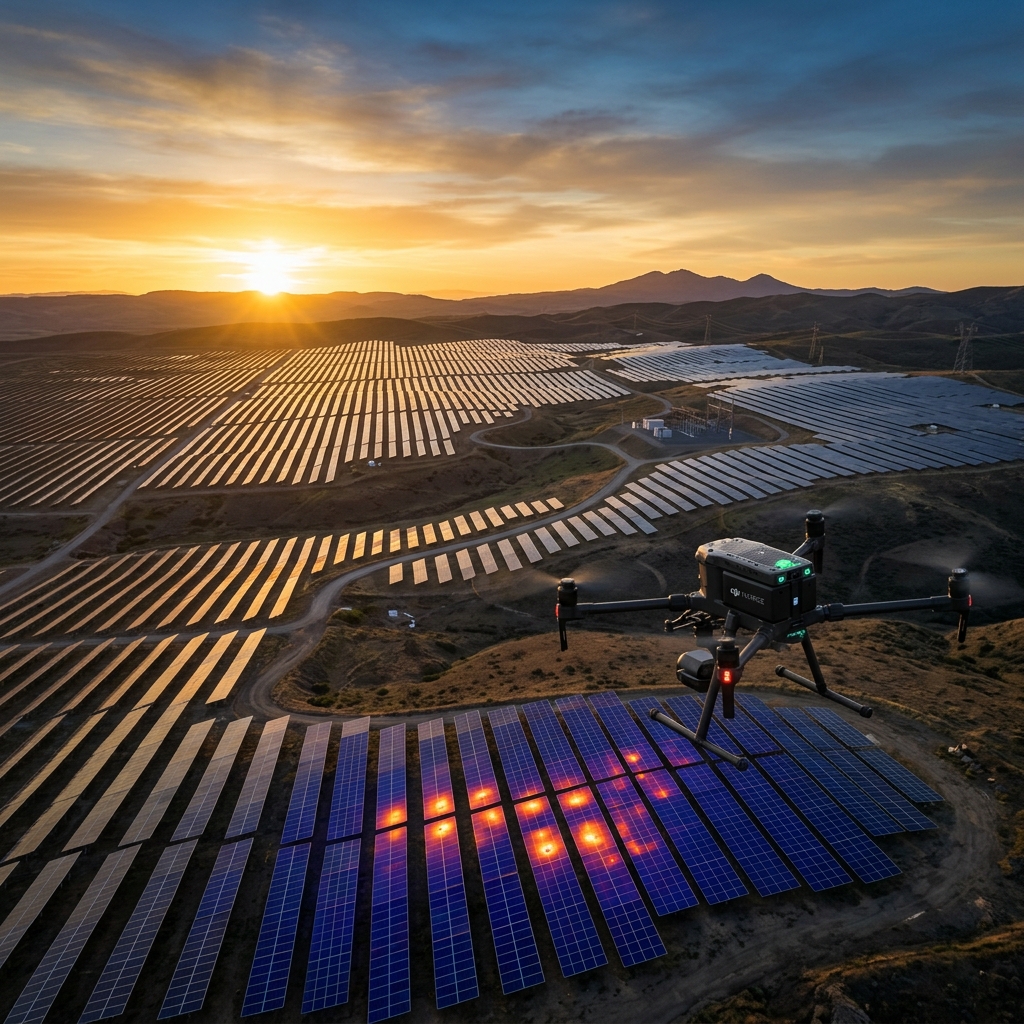
Solar power plants depend on thousands of photovoltaic (PV) modules working together to generate electricity. Even when a solar installation appears normal during a visual inspection, individual modules, strings or electrical connections may experience abnormal heating that affects performance and requires investigation.
Drone thermal inspection of solar panels uses an unmanned aerial vehicle (UAV) equipped with a radiometric thermal camera to capture infrared images of a solar installation. These images help inspection teams identify unusual temperature patterns across modules and electrical components, locate areas that may require attention, and prioritise further maintenance.
Unlike a basic visual survey, aerial thermography provides a temperature-pattern view of large solar installations. It can help operations and maintenance (O&M) teams screen extensive solar farms without manually examining every module from close range.
However, thermal imaging must be performed under suitable environmental and operating conditions. A thermal anomaly is an indication that something may need investigation—not automatic proof of a defective solar panel.
This guide explains how drone-based solar thermal inspection works, what it can identify, how inspections are conducted, and where the technology has limitations.
Planning a thermal inspection for your solar plant? Explore Agmay's drone solar inspection services for aerial thermal imaging, hotspot detection and O&M reporting.
What Is Drone Thermal Inspection of Solar Panels?
Drone thermal inspection is the process of surveying photovoltaic modules and associated solar infrastructure using an aerial platform carrying an infrared camera.
The camera detects infrared radiation emitted by surfaces and converts it into a thermal image. Different colours represent different apparent temperature levels, allowing analysts to identify temperature patterns that may be unusual compared with surrounding modules or components.
In a solar installation, these patterns can help reveal potential issues such as:
- Localised heating within a photovoltaic module.
- Cell-level or module-level temperature irregularities.
- Potential bypass diode-related thermal patterns.
- Differences between modules operating under similar conditions.
- Abnormal heating around electrical connections or other accessible components, where image resolution and inspection conditions are suitable.
The inspection generally combines two forms of imagery:
Thermal imagery: Shows temperature patterns and helps identify areas requiring technical assessment.
RGB imagery: Provides a conventional visual view to help locate modules, identify physical damage and correlate thermal findings with the actual installation.
Combining both image types makes it easier to identify the location and context of a suspected anomaly.
How Does Drone-Based Solar Panel Thermal Inspection Work?
A drone thermal inspection follows a planned process. The objective is not simply to capture aerial photographs, but to collect usable thermal data under controlled conditions and connect potential findings to identifiable locations within the solar plant.
1. Solar Plant Assessment and Flight Planning
The inspection team first reviews the solar plant layout, module arrangement, access restrictions, flight boundaries and areas requiring inspection.
The flight plan should account for:
- Total installation area and module arrangement.
- Required image overlap and inspection coverage.
- Drone flight altitude and camera field of view.
- Thermal camera resolution and measurement capability.
- Wind, cloud cover and expected solar irradiance.
- Flight permissions and applicable aviation requirements.
A planned route helps reduce missed areas and supports consistent image acquisition.
2. Thermal Camera and RGB Camera Configuration
The UAV carries a thermal imaging sensor capable of capturing infrared data. A separate or integrated RGB camera may also be used to capture visual references.
The thermal camera's suitability depends on more than its advertised resolution. Relevant considerations include:
- Thermal sensitivity.
- Radiometric capability.
- Geometric resolution at the intended flight altitude.
- Calibration and measurement accuracy.
- Lens and field-of-view characteristics.
- Image synchronisation and data recording.
The camera must provide sufficient detail for the inspection objective. If individual modules or smaller components cannot be resolved adequately at the selected altitude, the flight plan or sensor configuration must be adjusted.
3. Aerial Thermal Image Acquisition
The drone follows the planned route while capturing thermal images of the PV modules.
The pilot and inspection team monitor flight stability, camera orientation, image quality, environmental conditions and coverage.
The survey should minimise:
- Motion blur.
- Unwanted reflections.
- Drone-induced shadows.
- Inconsistent camera angles.
- Missing or overlapping coverage that cannot be reconciled.
- Changes in operating or environmental conditions during acquisition.
The thermal images should be associated with the corresponding visual images and inspection location wherever the system supports this workflow.
4. Thermal Image Processing and Analysis
After the flight, the captured images are reviewed and processed.
The analysis team examines temperature patterns and identifies areas that differ from comparable modules or components. Relevant findings are checked against the image quality, operating conditions and available plant information.
A thermal anomaly may be classified for further investigation, but its underlying cause should not be assumed from colour patterns alone.
5. Defect Mapping and Inspection Reporting
Potential findings are mapped to their locations in the solar plant.
A useful report should help the maintenance team understand:
- Where the suspected anomaly is located.
- Which module, row, block or component is affected.
- What the thermal image shows.
- Whether a corresponding RGB image is available.
- What environmental and operating conditions were recorded.
- What follow-up inspection or testing is recommended.
This converts aerial imagery into information that can support maintenance planning.
What Can Thermal Drone Inspection Detect in Solar Panels?
Thermal imaging can reveal several patterns that may indicate abnormal operating conditions. Interpretation depends on the PV technology, system configuration, inspection conditions and image resolution.
1. Hotspots and Localised Heating
A hotspot is a localised area that appears hotter than its surroundings.
In a PV module, localised heating may be associated with cell damage, mismatch, shading-related effects or other electrical and operational conditions.
Thermal imaging can help locate these areas for further investigation. It cannot independently confirm the exact cause of every hotspot.
2. Cell-Level Temperature Irregularities
Individual cells or groups of cells may show temperature patterns that differ from the rest of a module.
These patterns may be associated with electrical mismatch, cell damage or other abnormal operating conditions. Sufficient thermal resolution is essential to identify smaller patterns reliably.
3. Bypass Diode-Related Patterns
Bypass diodes are used in PV modules to provide an alternative current path under certain conditions.
Abnormal temperature patterns may indicate a possible bypass diode issue or a condition affecting the associated cell substring. Further electrical testing may be necessary to establish the actual fault.
4. Module-Level Temperature Differences
Modules operating under similar conditions can be compared to identify unusual temperature differences.
An isolated module with a distinctly different thermal pattern may warrant investigation. The comparison should account for shading, orientation, soiling, operating conditions and other factors that influence surface temperature.
5. Potential Electrical Connection Abnormalities
Thermal imaging may help identify abnormal heating around accessible electrical components, connectors or connections when the inspection geometry and sensor resolution are appropriate.
These components can be smaller than a complete PV module. Consequently, an aerial survey may not provide sufficient detail for every connection-level assessment. Close-range thermography and electrical testing may be required.
Important Conditions for Accurate Solar PV Thermography
A thermal camera does not produce equally reliable results under all weather and operating conditions.
The IEC TS 62446-3:2017 technical specification provides guidance for outdoor infrared thermography of PV systems. It describes environmental conditions, equipment considerations, image evaluation and inspection approaches.
Some important considerations include:
| Inspection parameter | Technical consideration |
|---|---|
| Solar irradiance | The specification identifies a minimum of 600 W/m² in the plane of the PV modules for module inspection. |
| Wind speed | The specified maximum is 4 Beaufort, approximately 28 km/h. |
| Cloud cover | The specification limits cumulus cloud coverage to 2 oktas. |
| Soiling | No or low soiling is preferred; significant contamination can affect interpretation. |
| Operating conditions | Module or string operating current and plant conditions should be considered when interpreting images. |
| Image quality | Thermal resolution, geometric resolution, camera characteristics and viewing geometry affect what can be identified. |
These are technical reference conditions, not a guarantee that every survey conducted within them will produce a definitive diagnosis.
Why Irradiance Matters
Solar modules generate electrical power when exposed to sunlight. Thermal patterns associated with operating conditions become more useful for assessment when the plant is operating under suitable irradiance.
If irradiance changes significantly during the inspection, the thermal patterns may change as well. Recording the conditions helps analysts interpret the images correctly.
Why Wind Affects Thermal Images
Wind can cool module surfaces and influence temperature distribution. Strong or changing airflow may reduce or alter the thermal contrast between components.
Why Cloud Movement Matters
Changing cloud cover can cause rapid variations in solar irradiance. This can make comparisons between images less reliable if operating conditions are not sufficiently stable.
Why Soiling Must Be Considered
Dust, bird droppings and other surface contamination can influence the observed thermal pattern. An apparent anomaly may therefore require visual inspection before it is classified as an electrical defect.
Benefits of Drone Thermal Inspection for Solar Farms
Large-Area Inspection Coverage
Aerial thermography can capture thermal imagery across extensive PV installations. It helps inspection teams assess large areas without manually approaching every module.
Faster Identification of Areas Requiring Attention
Thermal image analysis can help prioritise modules and sections that require further investigation, rather than relying exclusively on manual visual checks.
Location-Based Maintenance Planning
When thermal findings are linked to plant layouts and mapped locations, maintenance teams can identify where follow-up work is needed.
Reduced Need for Close-Range Screening
Aerial inspection can reduce the amount of manual walking and close-range screening required for initial identification of potential abnormalities. It does not eliminate the need for technicians to carry out corrective work or detailed electrical diagnostics.
Repeatable Inspection Records
Thermal and RGB image records can support comparison between inspection campaigns, provided that acquisition conditions and methods are sufficiently consistent.
Drone Thermal Inspection vs Conventional Solar Panel Inspection
Drone thermography and conventional inspection methods serve related but different purposes. They should be considered complementary rather than interchangeable.
| Inspection approach | Primary purpose | Important limitation |
|---|---|---|
| Manual visual inspection | Identify visible damage, contamination and physical conditions | Time-consuming across large installations |
| Drone RGB inspection | Capture aerial visual records and identify visible patterns | Cannot directly measure thermal behaviour |
| Drone thermal inspection | Screen for abnormal temperature patterns | Does not independently confirm the underlying electrical fault |
| Handheld infrared inspection | Examine selected modules or components at closer range | Requires access and is less suited to rapid coverage of extensive areas |
| Electrical testing | Investigate electrical performance and confirm suspected issues | Requires suitable instruments, procedures and qualified personnel |
A well-planned solar inspection programme can use aerial thermography for broad screening and targeted technical testing for confirmation.
Limitations of Drone Solar Thermography
Drone thermal inspection is valuable, but its results depend on the quality of the data and the expertise used to interpret it.
1. A Thermal Anomaly Is Not Always a Confirmed Defect
A hot or cold area may result from shading, soiling, reflections, changing irradiance, wind or other environmental effects.
An anomaly should be reviewed in context before it is classified as a fault.
2. Thermal Resolution Limits Detection
The ability to identify a small abnormality depends on camera resolution, lens characteristics, distance from the target and flight geometry.
A thermal camera that can identify module-level differences may not necessarily resolve individual cells, ribbons or small electrical connections.
3. Environmental Conditions Affect Reliability
Wind, cloud movement, unstable irradiance and surface contamination can affect observed thermal patterns.
If conditions are unsuitable, the inspection may need to be rescheduled or the affected findings treated with additional caution.
4. Thermal Imaging Does Not Replace Electrical Testing
Infrared images show surface temperature patterns. They do not directly measure every electrical characteristic of a PV module or string.
Depending on the suspected issue, further investigation may involve electrical measurements, I-V curve tracing, insulation testing, visual examination or other appropriate diagnostic procedures.
5. Data Processing and Interpretation Require Expertise
Capturing thermal images is only one part of the inspection. Analysts must understand PV system behaviour, thermal imaging principles, environmental influences and the limitations of the equipment.
Poor interpretation can lead to unnecessary maintenance or missed abnormalities.
What Should a Professional Drone Thermal Inspection Report Include?
An inspection report should provide enough information for a solar plant owner or O&M team to review findings and decide what action to take.
A useful report may include:
- Inspection overview: Site, date, surveyed capacity or area, inspection scope and methodology.
- Environmental conditions: Irradiance, ambient temperature, wind, cloud cover and relevant surface conditions, where recorded.
- Equipment information: Drone platform, thermal camera details, relevant sensor specifications and acquisition settings.
- Thermal imagery: Images showing the identified temperature patterns.
- RGB reference imagery: Corresponding visual images to help identify the affected location.
- Defect or anomaly mapping: Location references linked to the site layout, block, row or module where available.
- Finding classification: Description of the observed pattern and its priority for review, using a clearly explained classification method.
- Recommended next steps: Suggested visual inspection, electrical testing, cleaning or further technical assessment where appropriate.
The report should distinguish between an observed thermal anomaly, a suspected issue and a confirmed defect. This distinction helps prevent incorrect maintenance decisions.
When Should a Solar Plant Undergo Drone Thermal Inspection?
The appropriate inspection frequency depends on plant size, operating history, environmental conditions, maintenance strategy and the requirements of the asset owner.
Drone thermography may be considered during:
- Commissioning and post-installation assessments.
- Periodic solar plant maintenance programmes.
- Investigations following unexpected performance changes.
- Inspections after severe weather or other events that may affect the installation.
- Follow-up assessments after corrective maintenance.
- Investigations of underperforming blocks or strings.
Thermal inspection should form part of a wider PV inspection and maintenance programme rather than being treated as a substitute for all other testing.
Drone Thermal Inspection Services for Solar Plants in India
India's solar installations operate across a wide range of climatic and environmental conditions. Dust, seasonal weather changes, high ambient temperatures and site-specific operating conditions can all influence inspection planning and interpretation.
Agmay Technologies provides drone-based solar inspection solutions that combine aerial data capture and thermal imaging to help assess solar installations.
The inspection approach can support:
- Aerial thermal surveys of solar installations.
- RGB visual inspection and image correlation.
- Identification and mapping of potential thermal anomalies.
- Solar plant imagery and location-based reporting.
- Inspection information to support O&M planning.
The appropriate inspection scope, sensor configuration, deliverables and technical validation requirements should be determined according to the solar plant and the intended inspection objectives.
Planning a thermal inspection for your solar installation?
Discuss your solar plant layout, inspection objectives, thermal imaging requirements and reporting expectations with Agmay Technologies.
Explore Solar Inspection Services ↗For a broader introduction to UAV-based solar inspection, read our existing guide: Drone Solar Inspection: A Guide to Aerial Solar Panel Inspection.
Frequently Asked Questions
What is drone thermal inspection of solar panels?
Drone thermal inspection uses a UAV equipped with an infrared camera to capture temperature patterns across photovoltaic modules and selected solar plant components. The images help identify potential abnormalities that may require further investigation.
What can a thermal drone detect in a solar panel?
Depending on sensor resolution and inspection conditions, thermal imaging can help identify hotspots, unusual cell or module temperature patterns, possible bypass diode-related abnormalities and potential heating around accessible electrical components.
Can drone thermal imaging detect solar panel hotspots?
Yes. Thermal imaging can help locate areas that appear hotter than surrounding cells or modules. The underlying cause must be evaluated because environmental and operating conditions can also influence the observed temperature.
What irradiance is required for solar panel thermal inspection?
IEC TS 62446-3:2017 specifies a minimum irradiance of 600 W/m² in the plane of the PV modules for module inspection. Other conditions, including wind, cloud cover and operating current, should also be considered.
Is drone thermal inspection better than manual solar panel inspection?
Drone thermography is useful for screening large installations and locating potential thermal abnormalities. Manual visual inspection and electrical testing remain important for examining and confirming specific issues. The most appropriate method depends on the inspection objective.
Can drone thermal inspection identify every solar panel defect?
No. Thermal inspection cannot identify every physical or electrical defect. Some faults may not produce a detectable temperature pattern, and smaller abnormalities may be below the camera's resolution. Other inspection and testing methods may be necessary.
Does a thermal image confirm that a solar panel is faulty?
No. A thermal anomaly is an observation that requires interpretation. Shading, soiling, reflections, wind and changing irradiance can affect the image. Further assessment is needed before confirming a defect.
Why are RGB images used along with thermal images?
RGB images provide a visual reference that helps analysts locate and understand the physical condition of an area showing an unusual thermal pattern. Using both image types improves the context available for inspection reporting.
Can drone thermal inspection be used for large solar farms?
Yes. UAV-based thermography can be planned for large solar installations and can help collect aerial thermal data across extensive module arrays. Coverage, flight planning, battery capacity, sensor resolution and environmental conditions must be considered.
How often should solar panels undergo thermal inspection?
There is no single inspection frequency suitable for every solar plant. The schedule should consider plant performance, operating history, environmental exposure, maintenance requirements and the asset owner's inspection programme.
Conclusion
Drone thermal inspection of solar panels provides a practical way to screen photovoltaic installations for unusual temperature patterns and identify areas that may require further technical investigation.
Its value depends on more than the drone or thermal camera. Appropriate inspection conditions, suitable sensor resolution, controlled image acquisition, accurate location mapping and knowledgeable interpretation are all essential.
When combined with visual inspection, electrical diagnostics and a structured maintenance programme, aerial thermography can support more informed solar plant inspection and O&M decisions.
Planning a thermal inspection for your solar installation? Contact Agmay Technologies to discuss a drone-based solar inspection approach suited to your project.