
Advanced UAVs
Hybrid Fixed-Wing VTOL
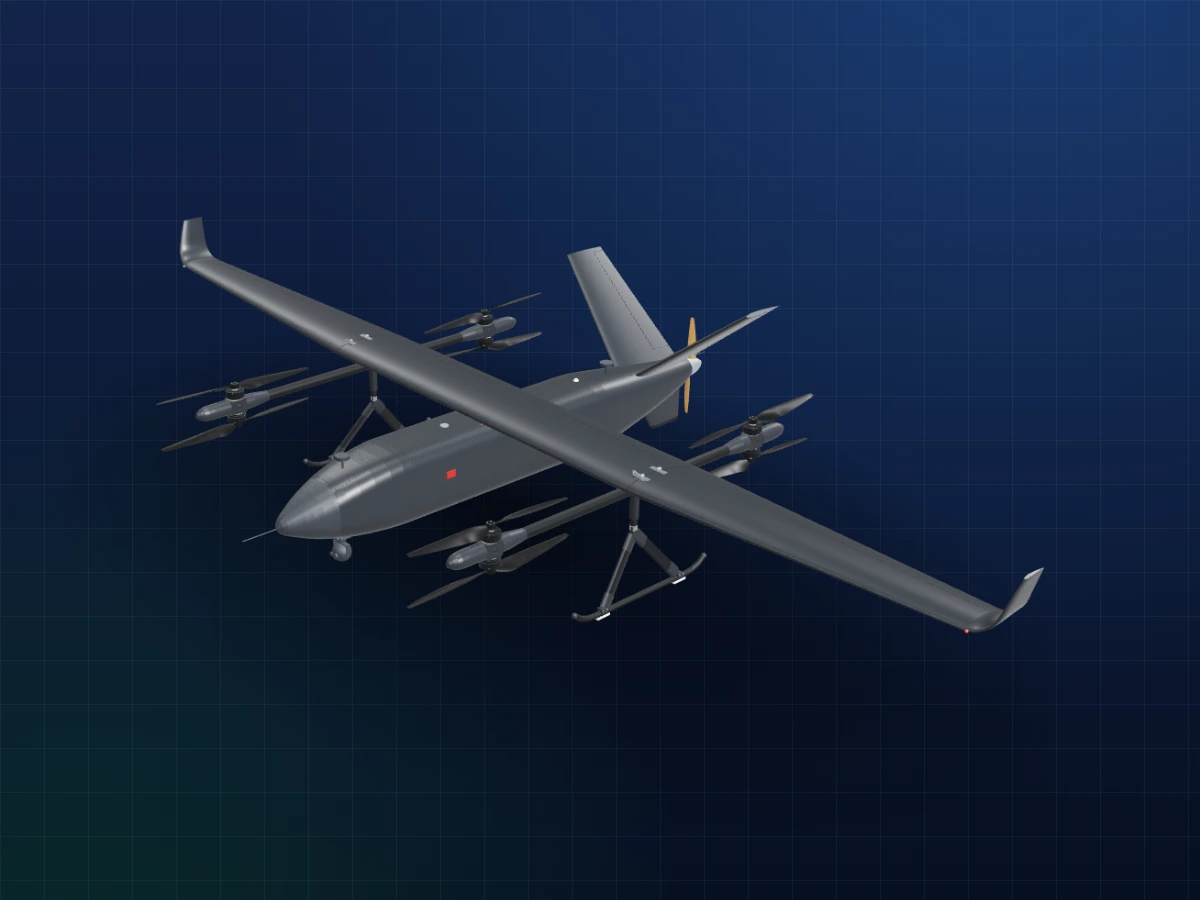
Agmay AeroVTOL-X
Vertical takeoff with pusher fixed-wing cruise for 50+ km corridor mapping & surveillance
- Capacity
- 50+ km Range
- Payload
- 2.5 kg
- Flight time
- 90 - 120 minutes
DGCA-authorised RPTO No. 23/2025 · Designed and built in India
Heavy-Lift Hybrid Cargo VTOL · In development
The HL-30 is a heavy-lift hybrid VTOL cargo drone in development. It lifts straight up on eight electric rotors, then a fuel-injected engine flies it on its wing and recharges the lift batteries on the way, carrying 30 kg for 7.4 hours or 772 km. For take-off and landing the outer wings fold up, shrinking its width from 6.4 m to 2.7 m.
Highlights
Applications
Specifications
The HL-30 is in development. These figures are from design revision C: the CAD model and its structural and flight analysis of 19 November 2026.
Explore the HL-30 in 3DInteractive 3D model · 541 parts · 3.8 MB: the folding wing, how it flies, what is inside and the full specification| Payload | 30 kg in an internal bay |
|---|---|
| Endurance | 7.4 h with 30 kg, 30 min reserve kept |
| Range | 772 km with 30 kg |
| Best-range speed | 29 m/s (104 km/h) |
| Max level speed | 38 m/s (137 km/h) |
| Max Takeoff Weight | 132.3 kg |
| Operating empty mass | 83.8 kg |
| Wingspan | 6.4 m |
| Width, wings folded | 2.7 m; 3.3 m across the rotor discs |
| Length | 3.26 m; 3.46 m with the pitot probe |
| Wing fold | 90° in 2.5 s; unfolds above 10 m |
| Lift motors | 8 × 24S outrunners in four coaxial pairs, 26 kgf peak each, 40 × 13 in carbon propellers |
| Thrust / weight | 1.57 all motors; 1.38 with one out |
| Cruise engine | 110 cc two-stroke boxer twin, fuel injected, 26 × 12 in pusher |
| Fuel | 18.5 kg (25 L) |
| Lift battery | 2 × 12S 22 Ah LiPo in series: 24S, 88.8 V, 1.95 kWh |
| In-flight charging | 1.2 kW 48 V starter-generator, 600 W charger, full in about 0.7 h |
| Crosswind, wings folded | 13.5 m/s |
| Payload system | Internal bay, 2 × 100 kg hooks, 15 m winch, air-drop kit |
| Recovery | Ballistic parachute with an independent trigger |
| Avionics | Triple-IMU autopilot, dual RTK GNSS, datalink, RC link, ADS-B |
| Structure | Carbon fibre; ultimate factor of safety 2.0 |
VTOL, cargo and specialised UAVs
Hybrid Fixed-Wing VTOL
Vertical takeoff with pusher fixed-wing cruise for 50+ km corridor mapping & surveillance
10kg Cargo Logistics UAV
Heavy-duty logistics delivery drone with 10kg payload bay and tethered winch delivery
High-Rise Cleaning Drone
Tethered facade washer reaching 120m height with 300 Bar high-pressure wash nozzles
FAQ
HL-30 enquiries
Tell the Agmay team about your route, payload and landing site, and the right person from our team will get back to you.
Monday to Saturday, 9:00 am – 6:30 pm